Keris Mistakology

sumber foto: pasarmadura.com
By Dwi Fitria
Due to Indonesia’s paternalistic culture, it often happens that people asks for information on keris to them who are considered the elderly.

According to Toni Junus, the General Secretary of Panji Nusantara, a keris enthusiast organization, there are many wrong perception on keris that goes on in public. “Some of them are the percep-tions that keris is a mystical item that can bring people wealth, strength, luck, and others.”

Keris has thousands of motive (charm) alternatives with each their own meaning. The motives represent the wish of the person who ordered the making. “For instance the udan motive, which has the meaning of wealth. The keris in this matter plays the role of a motivational item to get the owner working more diligently and yielding wealth.”

Due to the paternalistic Indonesian culture, it often happens that people ask for information to the elderly, when not all of them have sufficient knowledge and comprehension on the keris. “Because of the lack of basic knowledge, it’s easy for them to say that the keris is an item of horror that requires cleansing and so on and so forth,” said Toni.

Other misconception on the keris is located on the custom of cleansing (bathing) it. The main goal of this process is to pre-vent the keris from corrosion. However for many people the process then goes on a different interpretation to a ritual to honor the keris as a mystical item that is perceived to have supernatural powers. Bathing is done to “please” the super-natural entiry that dwells in the keris.

“This mistake started with the tradition of keris bathing in the roy-alty. The kings back then needed a way to preserve the hegemony of their regime; that is why they feel something needs to be done in the name of ‘communal sacred” ceremony,” explained Toni.

And then evolved the sacred keris cleansing ceremony in the month of Suro that is then continued with a parade to carry the charms around the area. The ceremony then progresses to the praying rituals to wish the country wealth, protection from diseases, and others.

“This is a positive gesture, but what’s wrong is common people’s interpretation that claims the keris must be cleansed to keep the spirits from raging. When in all truth, that is not the meaning of cleansing,” Toni regretted.

The process of keris cleansing is firstly done by mixing warangan (arsenic crystal compound) with citric acid (usually from lemon juice). The formula is used to prevent corrosion on the Keris. In the process of keris making, the compound is also used to bring out different colors on the keris’ charm (motive). After the cleansing process is done, the keris is then smeared with oil to complete the anti-corrosion layer on the keris.

Unfortunately the formula of warangan compound and citric acid also has a damaging character when done too many times. “That is why many of the keris then get damaged,” Tony elaborated.

Once a foreign researcher namely Garret Soul Young said to him that a keris should actually be cleansed only once every ten years. “As long as the keris is not contaminated by salt or water, the chemical compounds used is effective enough to prevent it from corrosion.”

Toni perceives the misunderstanding of keris as one of the main reasons why modern society tend to keep their distance with the item. “Without knowing they already see it as a mystical item, afraid of infidelity and all.” That is why he tries hard to straight the misun-derstanding back.

Together with Panji Nusantara, Toni makes the effort of conduct-ing various activities for the sake of popularizing keris back to soci-ety. One of which is by making a simple periodicity to qualify keris based on the time of produce. “There are only two main qualifica-tions; before and after independence. The keris those are made after independence are called the Kamardikanis.

Collectors used to be interested in purchasing keris from old ages, but now the Kamardikan keris have gained a place in public, During the grand exhibition of Keris for the World held at the Indone-sian National Gallery a while back, many of the Kamardikan keris were retailed with high pricing. The works of Toni, Nyi Kanjeng Daratista (several kerises those were made inspired by the singer Inul Daratista) were purchased by a collector with the price of mil-lions of rupiah. n

take from: arti edisi 29, juli 2010
READMORE Keris Mistakology

The Wealth of Batik

Indonesian Batik is filled with techniques, symbols, and supreme artistic values.

Friday, 2 October 2009; the weather in Abu Dhabi or United Arab Emirates was rather bright and not so hot, thanks to the breezes of wind that come and go. The sky was also blue, as if providing a shade for the city that is located at 24°28’ Northern Latitude and 54°22’ Eastern Longitude. Skyscraper buildings stood tall, strong and luxurious. At one of the most known buildings in the City of Abu Dhabi that afternoon, the Committee of 24 countries from Unesco (United Educational, Scientific, and Culture Organization) at their last assembly decided and declare officially the enlisting of Batik into the Representative List of Intangible Cultural Heritage.

Indonesian Batik becomes a part of 76 arts and traditions of the 27 countries that Unesco claimed in the Representative List of Intangible Cultural Heritage through the decision of 24 countries committee that assembled seriously before determining their official declarations. In-donesian Batik was perceived as filled with techniques, symbols, and cultures those are inseparable from the community since their birth to their death. The good news was of course taken whole-heartedly by the Indonesian nation while keep on praising Almighty God.

The announcement of batik’s enlisting in the Representative List of Intangible Cultural Heritage – Unesco in Abu Dhabi or United Arab Emirates; becomes a great pride to Indonesia. Doddy Soepar-di of the Indonesian Batik Foundation Guidance Council claimed to be optimistic that batik will evolve more in the future. Along with the progresses of designer products, motives or varieties of batik will also experience significant evolution. Unesco’s declaration towards batik affirmed it to be the third Indonesian cultural heritage that is approved globally. Before this, Unesco has declared wayang/ shadow puppet (2003) and the keris (2005) as the master-pieces of verbal culture and intangible cultural heritage.

The Minister of Culture and Tourism; Jero Wacik said that, with global approval toIndonesian batik, the obligation of Indonesian society to preserve the nation’s heritage becomes more evident. “We do not forbid other nations from using Indonesia’s cultural products. However, when there are claims or admissions of them as the possession of other countries, we must not stay still,” he affirmed.

This international affirmation of Indonesian batik does not mean that the Indonesian people themselves do not appreciate batik. The evolu-tion of batik must remain, so it will always be a part of the people’s daily lives. Indonesian government is also aspired to strengthen the promotion. Thus, the existing batik centrals can progress and will be able to present more uniqueness in batik creations.

Indonesian Batik was enlisted in the Representative List of Intan-gible Cultural Heritage due to the historical, philosophical, and re-ligious aspects that found the creating process. Unesco judgment is not just the Indonesian batik pattern that is worldly acclaimed.

The acclamation of United Nations towards Indonesian Batik is a form of pride that also escalates the nationalism of the Indonesian nation. This international appreciation is hoped to resurrect the batik industry in the regions. And batik must also be understood and not only seen as a mere outfit. Batik is the reflection of Indonesian national culture, the indepen-dent and creative customs.

According to Hasanudin – a batik designer – in his book titled Coastal Batik Tracks the Influence of Religious Trading Ethos in the Various Decorative of Batik (2001), the influence of Chinese, Indian and Islamic cultures is rather immense in forming the vari-ous decorative of the nation’s textile and batik. Chinese various decorative is portrayed dynamic such as a meander that is rhyth-mically arranged, the shape of clouds, swastika that faces right or the entwining spirals. Aside from that the motives of phoenix bird and dragons in motion also comes from Chinese influence.

It is not only motives those are related to the existence of ba-tik. The definition of batik itself is inseparable from the pro-cess of batik creating which uses the dip-cover process; that is to dip in coloring substance, the cloth that has been covered by malam on certain parts.

Yan Yan Sunarya, the lecturer of the Fine-Arts and Design Faculty of Bandung Technological Institute explained that if the making process does not go through the dip-cover method, then the produced item cannot be called batik. The process of batik it-self consists of design, malam printing (using canting/ stamp/ brush), coloring (dip/ colet), color enhancing, drying, and rinsing by pelodon (malam rinsing). The pelodon rinsing is the last phase and afterwards the batik cloth is ready to be made into wardrobes or inte-rior designs as required.

The history of batik in Indonesia comprise of two kinds of batiks those are characterized based on the producer and production location, which are the kraton batik (Sura-karta and Jogjakarta) and coastal batik. Kraton batik is meant only to serve the interest of kings, palace officials, and palace employees, including the soldiers. Aside be-ing assigned for the king’s “official wear”, batk is also used in weddings, birth, death, and dance art. It is also used in various palace traditional ceremonies. Batik cloths are often used as sarongs, long dress, tube top, shirt, head wrap, scarf, and wall interior decoration.

At the times of Mataram Islamic empire in Jogjakarta and Surakarta, Yan Yan Sunarya told, the making of ba-tik cloths with the expression of artistic values with vari-ous complex, detailed and soft decora tive was developed. Making batik was even made as the symbol of well-man-nered upbringing of the royal families.

In its journey, the antithesis of kraton batik is the coastal batik. This batik is produced at the coastal re-gions of Java, all the way from Indramayu, Cirebon, Pekalongan, Lasem, Rembang, Juwana, Tuban, Sido-arjo, Pacitan, through Madura. What differs the two is that coastal batik is the batik that is produced beyond the walls of kraton palace. The batik workers in Sura-karta and Jogjakarta those are beyond the walls of the palace are categorized in the coastal batik. This batik is also called by market batik, because the production of the batik is meant for retails and wears by the public society and does not go by social strata.

In Indonesia, for any official events, the gov-ernment officials and President all the way down to Head of the Village also wears ba-tik. President Susilo Bambang Yudhoyono, the ministers, members of the Board of Public Representation and other elite of-ficials along with the ambassadors from neighboring countries also wear batik in various national or ceremonial events.

History proves that batik is the result of Javanese society traditional cultural process that is inherit for generations. Even so, back then it was not yet called batik-printing. As the Grand Master of Archeology from Gaah Mada University, Timbul Haryono, the technique for cloth processing has been known even before the Hindu era in the Nation at about the 4th Century. The evident is cited in num-bers of ancient artifacts and statues.

Numbers of artifacts from the 9th Cen-tury acclaim that, the types of cloths pro-cessed are done through a technique sim-ilar to batik. One of them is the Balitung Artifacts that tells the story of a palace ball. “The description of this cloth is similar to the technique now known as batik. From these evident I’m convinced that batik is a Javanese native culture,” Timbul said.

The evident was also supported by the apparels on ancient statues. The motives on those stat-ues’ apparels have similarities to the kawung batik that is known nowadays. However, the origin of the word “batik” is still yet to be traced until now. From the likeness of sound, some assume that “batik” is made of two Java-nese words, which are “amba” and “titik” that means to make dots. But still, there is no solid proof of that assumption.

Timbul said that batik is not a sudden inven-tion. The processing technique is the result of a cultural process that is inherited for generations. The history of batik development in Java itself has even begun since prehistoric time. “But since the evident is rather minimal, then it is hard to trace,” he claimed.

The batik workers in Giriloyo and Karangtengah, I,ogiri, ad-mit that their skills in batik printing is inherited from gen-erations. Their ancestor’s skills came from the Keraton Jogja-karta. “This is inevitable from the regional factor that is close to the graveyard of Imogiri past kings. They are taught by the palace people during visits to the grave,” revealed Suryati (35), a craftswoman of Karangrejek, Karangtengah.

Untl now, there are at least 40 batik workers in Karangten-gah. They use natural coloring with two methods, which are hand-drawn and stamp. The stamp batik just came out recently because consumers often complain about the high price of hand-drawn batik. The said work is sold for Rp. 250 thousand up per cloth, while stamp batik is only for Rp. 50 to 100 thousand per cloth.

It is a totally different way with the traditional batik workers of Banaran, Kulon Progo. They perceive that the batik acclamation from Unesco has done nothing to escalate their livelihood. As long as there is no pride in wearing local batik cloths, the workers will remain in a bad condition. Widodo, a worker from Banaran even bet that out of all the people who wear batik this Friday, not even 10 percent is put-ting on local batik. The majority must wear Pekalongan or Solo batik those are less costly.

In fact, it is the print batik that really sets in the market. What is con-sidered truly batik are those of hand-drawn, stamp, and the combina-tion of both. Print batik is only cloth in batik motive. According to Murdjato Gardjito, General Secretary of the Sekar Jagad Batik Lovers Community, print batik will only destrot traditional batik industry, and also put a scar on the face of Indonesia. Low price has always been the appeal of print batik, such as those sold along the street of Malioboro. Tourists, especially locals, purchase them in bulks as sou-venirs for family and relatives. (Source: Arti magazine, and various other sources).

Teks by Rusdy Setiawan Putra.
Was publish at arti special edition page 38 - 42.
READMORE The Wealth of Batik

Angklung Soars More

From the Land of Sunda, the Indonesian Republic Government is fighting for the declaration of angklung instrument as the global heritage.

TEKS by Doddi Ahmad Fauji dan Devi Apriani

The area is beautiful and flourished by trees, located in the eastern part of Bandung. When evening sets in, it becomes crowded. Tens of children are dropped off by their parents, and there are those who come in cars of tour buses. What’s going on in there?

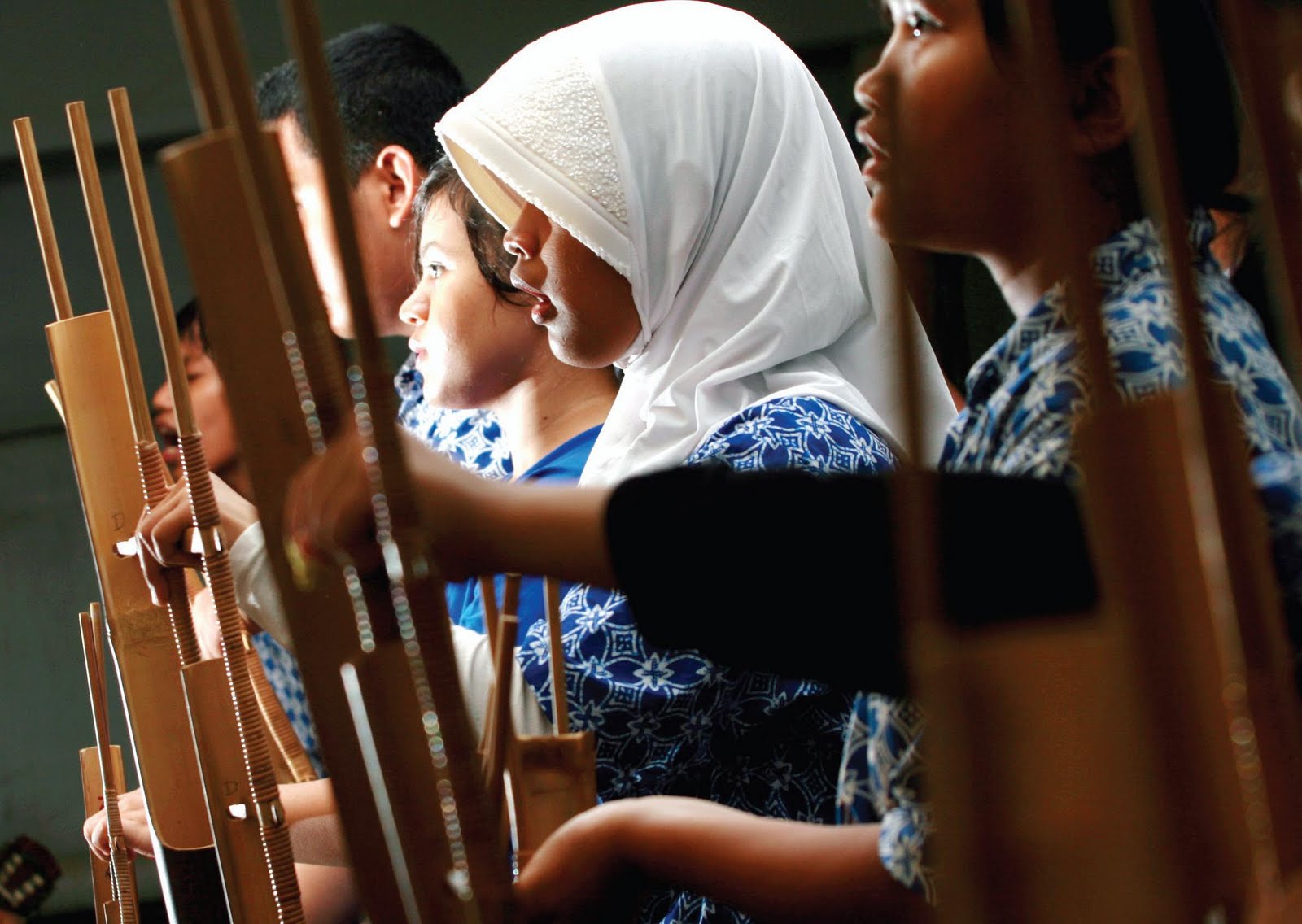
There; concerts of angklung music are constantly held. It is Sundanese people’s traditional music, and it is the angklung concert that has become the attraction of the place namely the Saung Angklung UJO (SAU). SAU is one of the many numbers of musical groups that concentrate on angklung music in West Java. It can be said that SAU is the one most active and tirelessly preserves the angklung and makes the angklung music a favorite, and even copycatted by musicians from the Neighboring Land of Malaysia.

In that country even, there is an area where angklung is frequently played, with a poster that mentions that angklung is Malaysian traditional music that is also recognized by artists from East Java. This is a misleading poster, because in Indonesia, angklung is commonly played by musicians from West Java.
Besides SAU, the art group that introduces angklung to foreign lands is the Kabumi fron Indonesian Educational University. There is also the choir from Pasundan University or Bandung Technology University that plays the angklung.

Although in Indonesia angklung is identified more as the possession of Sundanese artists, but those who play the angklung and instruments of sort are not just Sundanese artists. One of the references on the Samanyata bulletin Edition II/2009 published by the Department of Culture and Tourism mentioned that according to Dr. Groneman, angklung had already been a favorite of the entire Nation even before the Hindu era.

In Bali, for example, angklung is played also, especially in the events of ngaben (cremation ceremony). The Baduy Kanekes of South Banten also plays the angklung at time of cropping or yielding paddy fields. In Jati Village of Serang, the term angklung gubrag is known as the instrument that is played at times of village collective clearout, and as for the commencement of field cultivation, the Kulonprogo calls it the angklung krumpyung.

According to Yaap Kunst in Music in Java, angklung is also mentioned to exist in South Sumatra and Kalimantan (Soetigna in Sumarsono and Pirous, 2007: 2008). According to several info, angklung is also known in West Kalimantan, which item is kept in the Indische Institute Museum in Holland, listed in the catalogue No. 1297/1-2 dan 1767/1-3.

According to catalogue No. 40/58, traditional angklung is also played in Lampung. While in the Land of Sunda alone, angklung has various names such as the Angklung Badeng, Angklung Buncis, Angklung Dogdog lojor, Angklung Badud, Angklung Gubrag, Angklung Bungko.

The map of angklung expansion above shows that the musical instrument for the same sort of angklung is actually not only known by the people of West Java. It could well be too that the artists of our neighboring country knows angklung beforehand, remembering the existence of bamboo there. However, the type of angklung as we know it now is assured as the modification made by Daeng Soetigna, one of the angklung artists from West Java who was the most persistent in preserving angklung.

In the Samanya bulletin, it is said that in the year 1938, Daeng Soetigna who was a teacher at the Hollandsch Inlandsche School (HIS) of Kuningan District, West Java; was successful in developing modern angklung, that was only in pentatonic tones, to be made in diatonic. This angklung is commonly called the Angklung Daeng or Angklung Padaeng.In 1968, Daeng received the honor of “Cultural Satyalencana Honors” from the Republic of Indonesia. Since then Daeng mentioned the motto for angklung as the cheap, simple, educating, and attractive musical instrument.

In 1950, Daeng Soetigna developed the diatonic angklung in the City of Bandung. It was here that Daeng found a highly talented and eager student namely Udjo Ngalagena. After Daeng Soetigna departed, Udjo loyally concentrated on angklung to date. It is the place where he developed the angklung that stands in the beautiful and flourished area of East Bandung.

Taufik Hidayat, SAU operational Director explained that, Daeng Soetigna is an inseparable part of the Saung angklung Udjo's establishment, for it was from the said artist that Udjo’s interest in angklung grew stronger. Located in Padasuka 188 Street of East Bandung, at the beginning Saung angklung Udjo was only a common residence.

However, due to the interest that Udjo Ngalagena and his wife Uum sumiati have towards angklung, their house was finally turned into an angklung manufacturer. With time, the angklung manufacturer spot became known and started to get visits from foreign tourists. From there, Saung Angklung Udjo began its development into the sundanese culture art tourism destination as it is now.

The Indonesian Republic Government, through the Directorate General of Art Culture and Film Value (NSBF) of the Tourism and Culture Department, is fighting for angklung to be enlisted the global heritage. All of the requirements for that fight has been fulfilled and gone through. And now, we are all in wait for the juror that was assembled by Unesco to decide. Best of Luck.

Why should angklung be fought for as a global heritage? It is because angklung music is not only entertainment, but also guidance. In angklung music, there are values of discipline, awareness of duty and obligation, democratic, tolerance, confidence, collective work, precision, swift, and responsibility. Angklung cannot be played alone. That is why, cooperation is the important key in an angklung musical concert.

Source: arti special edition 2010
READMORE Angklung Soars More